
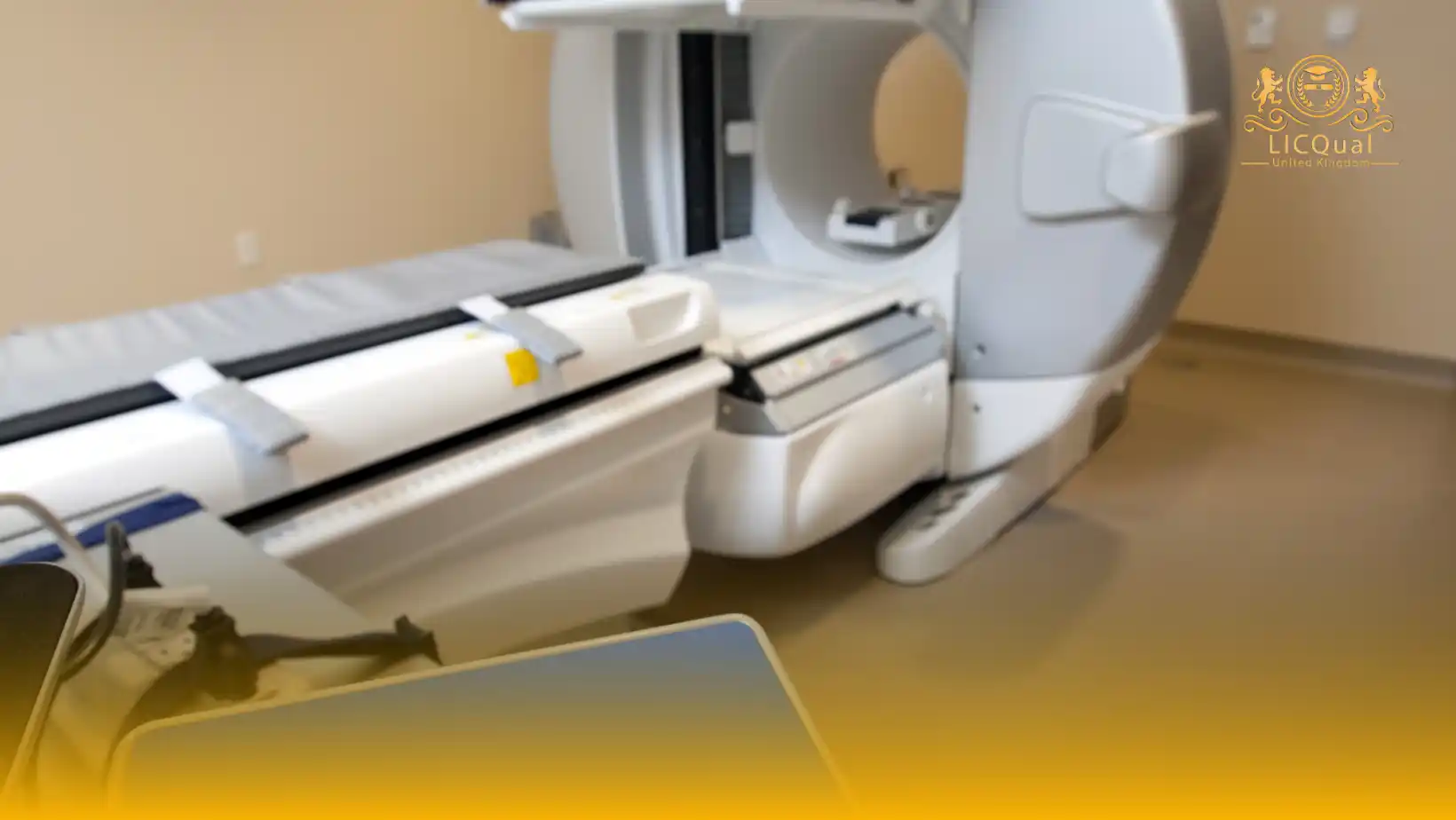
The LICQual Level 3 Diploma in Nuclear Medicine (Dip NM) is a specialised qualification designed for healthcare professionals who wish to expand their expertise in the advanced field of nuclear medicine. This diploma is not intended for fresh candidates; instead, it is tailored for experienced practitioners seeking to enhance their career prospects, gain in-depth knowledge, and strengthen their Continuing Professional Development (CPD).
Nuclear medicine is a rapidly evolving discipline that integrates medical imaging, molecular science, and patient care, playing a critical role in diagnosis and treatment. This qualification equips learners with the essential skills and theoretical understanding required to apply nuclear medicine techniques in clinical settings, ensuring accurate diagnostic processes and effective patient management.
Learners undertaking this diploma will benefit from a structured curriculum aligned with international standards, covering areas such as radiopharmaceuticals, imaging modalities, radiation safety, clinical applications, and quality assurance in nuclear medicine practice. The course places strong emphasis on practical application, enabling learners to confidently apply their knowledge in real-world healthcare environments.
Centres offering the LICQual Level 3 Diploma in Nuclear Medicine must ensure the delivery of high-quality training through competent and qualified staff, modern facilities, and access to updated learning resources. This guarantees that learners receive an engaging and supportive educational experience, empowering them to achieve professional excellence.
By completing this diploma, learners can significantly advance their professional profile, contribute to improved healthcare services, and strengthen their role within the medical imaging and nuclear medicine sector.
Course Overview
Qualification Title
LICQual Level 3 Diploma in Nuclear Medicine (Dip NM)
Total Units
6
Total Credits
60
GLH
240
Qualification #
LICQ2200894
Qualification Specification
To enroll in the LICQual Level 3 Diploma in Nuclear Medicine (Dip NM), applicants must meet the following criteria:
|
Qualification# |
Unit Title |
Credits |
GLH |
|---|---|---|---|
|
LICQ2200894-1 |
Fundamentals of Nuclear Medicine |
10 |
40 |
|
LICQ2200894-2 |
Radiation Physics and Safety |
10 |
40 |
|
LICQ2200894-3 |
Radiopharmaceuticals and Tracers |
10 |
40 |
|
LICQ2200894-4 |
Nuclear Imaging Techniques |
10 |
40 |
|
LICQ2200894-5 |
Clinical Applications of Nuclear Medicine |
10 |
40 |
|
LICQ2200894-6 |
Professional Practice and Ethical Considerations |
10 |
40 |
By the end of this course, learners will be able to:
Unit 1: Principles of Ophthalmology and Eye Health
- Explain the scope and role of ophthalmology within healthcare systems.
- Describe key concepts of eye health, visual function, and patient care.
- Analyse the impact of eye disorders on individuals and populations.
- Apply foundational knowledge to support safe and effective ophthalmic practice.
Unit 2: Anatomy and Physiology of the Eye
- Describe the structure and function of ocular components, including the cornea, lens, retina, and optic nerve.
- Explain physiological processes involved in vision and ocular health.
- Analyse how anatomical and physiological factors influence eye function and disease.
- Evaluate the effects of ageing, disease, and external factors on visual health.
Unit 3: Common Eye Disorders and Clinical Assessment
- Identify common eye conditions such as glaucoma, cataracts, macular degeneration, and refractive errors.
- Explain signs, symptoms, and diagnostic criteria for ocular disorders.
- Conduct appropriate clinical assessments to support accurate diagnosis.
- Apply evidence-based approaches to patient evaluation and care planning.
Unit 4: Diagnostic Techniques and Ophthalmic Procedures
- Explain key diagnostic tools used in ophthalmology, including visual acuity testing, tonometry, fundoscopy, and imaging.
- Describe common ophthalmic procedures and their applications in clinical practice.
- Interpret diagnostic findings to inform clinical decision-making.
- Evaluate the effectiveness and safety of diagnostic and procedural interventions.
Unit 5: Therapeutics, Treatment, and Patient Management
- Explain the role of therapeutic interventions, including pharmacological and surgical approaches.
- Develop care plans to manage common eye conditions effectively.
- Assess patient responses to treatment and adjust management plans accordingly.
- Analyse strategies for optimising patient outcomes in ophthalmic care.
Unit 6: Ethical Practice, Professional Standards, and CPD in Ophthalmology
- Demonstrate understanding of ethical principles and professional standards in ophthalmology.
- Apply principles of patient confidentiality, consent, and safeguarding in clinical care.
- Reflect on the importance of Continuing Professional Development (CPD) in maintaining competence.
- Develop strategies for lifelong learning and professional growth in ophthalmic practice.
The LICQual Level 3 Diploma in Nuclear Medicine (Dip NM) is designed for healthcare professionals, radiographers, and medical practitioners who want to specialize in nuclear imaging, radiopharmaceuticals, and diagnostic medicine. This accredited nuclear medicine diploma is ideal for those seeking CPD accreditation, career advancement, and practical skills in PET, SPECT, and gamma camera imaging. Whether you are already working in healthcare or planning to focus on nuclear diagnostics, this Level 3 qualification equips you with the expertise to deliver safe, evidence-based, and patient-centered care.
1. Doctors and Medical Practitioners
- Strengthen expertise in nuclear imaging and diagnostic medicine
- Gain advanced skills in PET, SPECT, and gamma camera applications
- Enhance qualifications with an accredited nuclear medicine diploma
- Apply evidence-based practices in hospitals and imaging centers
- Earn CPD points to support ongoing professional development
2. Radiographers and Imaging Technologists
- Build confidence in handling nuclear imaging equipment and protocols
- Learn strategies for radiopharmaceutical preparation and safety
- Strengthen qualifications with a CPD accredited nuclear medicine course
- Improve ability to support doctors in diagnostic and therapeutic procedures
- Gain practical skills for both hospital and research-based imaging
3. Medical and Healthcare Students
- Develop a strong foundation in nuclear medicine and imaging science
- Gain a competitive edge for future healthcare and research careers
- Access flexible online learning while continuing academic studies
- Learn practical approaches to radiation safety and nuclear diagnostics
- Earn a recognized Level 3 nuclear medicine qualification early in your career
4. Oncologists and Cancer Care Specialists
- Strengthen expertise in nuclear imaging for cancer diagnosis and treatment
- Learn strategies for integrating nuclear medicine into oncology care
- Build qualifications for roles in cancer centers and research institutions
- Gain skills in PET/CT imaging for tumor detection and monitoring
- Improve patient outcomes through advanced diagnostic techniques
5. Public Health and Community Health Practitioners
- Understand the role of nuclear medicine in population health systems
- Learn strategies for integrating nuclear diagnostics into health programs
- Contribute to national and global health initiatives in imaging and cancer care
- Build qualifications for roles in NGOs and government health agencies
- Apply nuclear medicine principles to community-level healthcare challenges
6. Researchers and Academic Scholars
- Enhance expertise in nuclear medicine and molecular imaging research
- Learn advanced methods in radiopharmaceutical development and safety
- Strengthen qualifications for academic and research careers
- Gain skills to contribute to medical innovation and diagnostic discovery
- Build a pathway toward higher-level specialization in nuclear medicine
7. Career Changers and Lifelong Learners
- Explore opportunities in healthcare, nuclear imaging, and diagnostics
- Gain an affordable and accessible qualification in nuclear medicine
- Build transferable skills for roles in education, research, or NGOs
- Learn at your own pace with flexible online study options
- Strengthen your CV with a recognized diploma in nuclear medicine
To deliver the LICQual Level 3 Diploma in Nuclear Medicine (Dip NM) effectively, approved centres must meet specific requirements to ensure high-quality training, learner success, and compliance with international academic and professional standards.
- Qualified and Experienced Staff – Centres must employ trainers, assessors, and internal verifiers with proven expertise in nuclear medicine, diagnostic imaging, radiopharmacy, or related healthcare fields. Staff should hold relevant qualifications and demonstrate continuous professional development (CPD).
- Access to Appropriate Facilities – Centres must provide access to well-equipped classrooms, laboratories, and simulation facilities that support the teaching of nuclear medicine practices, imaging techniques, and safety procedures.
- Learning Resources and Materials – Comprehensive and up-to-date learning materials, including reference texts, e-learning platforms, and case study resources, must be available for learners.
- Assessment and Quality Assurance – Centres must have robust systems in place for fair and transparent assessment, along with internal quality assurance processes aligned with LICQual standards.
- Health and Safety Compliance – Centres must follow strict safety protocols and ensure safe learning environments, particularly when covering radiation safety, radiopharmaceuticals, and diagnostic procedures.
- IT and Digital Resources – Access to online learning platforms, digital libraries, and specialised nuclear medicine software for imaging analysis and case studies should be provided.
- Commitment to Learner Support – Centres must demonstrate strong learner support mechanisms, including academic guidance, mentoring, and career development opportunities.
Assessment and Verification
All units within this qualification are subject to internal assessment by the approved centre and external verification by LICQual. The qualification follows a criterion-referenced assessment approach, ensuring that learners meet all specified learning outcomes.
To achieve a ‘Pass’ in any unit, learners must provide valid, sufficient, and authentic evidence demonstrating their attainment of all learning outcomes and compliance with the prescribed assessment criteria. The Assessor is responsible for evaluating the evidence and determining whether the learner has successfully met the required standards.
Assessors must maintain a clear and comprehensive audit trail, documenting the basis for their assessment decisions to ensure transparency, consistency, and compliance with quality assurance requirements.