
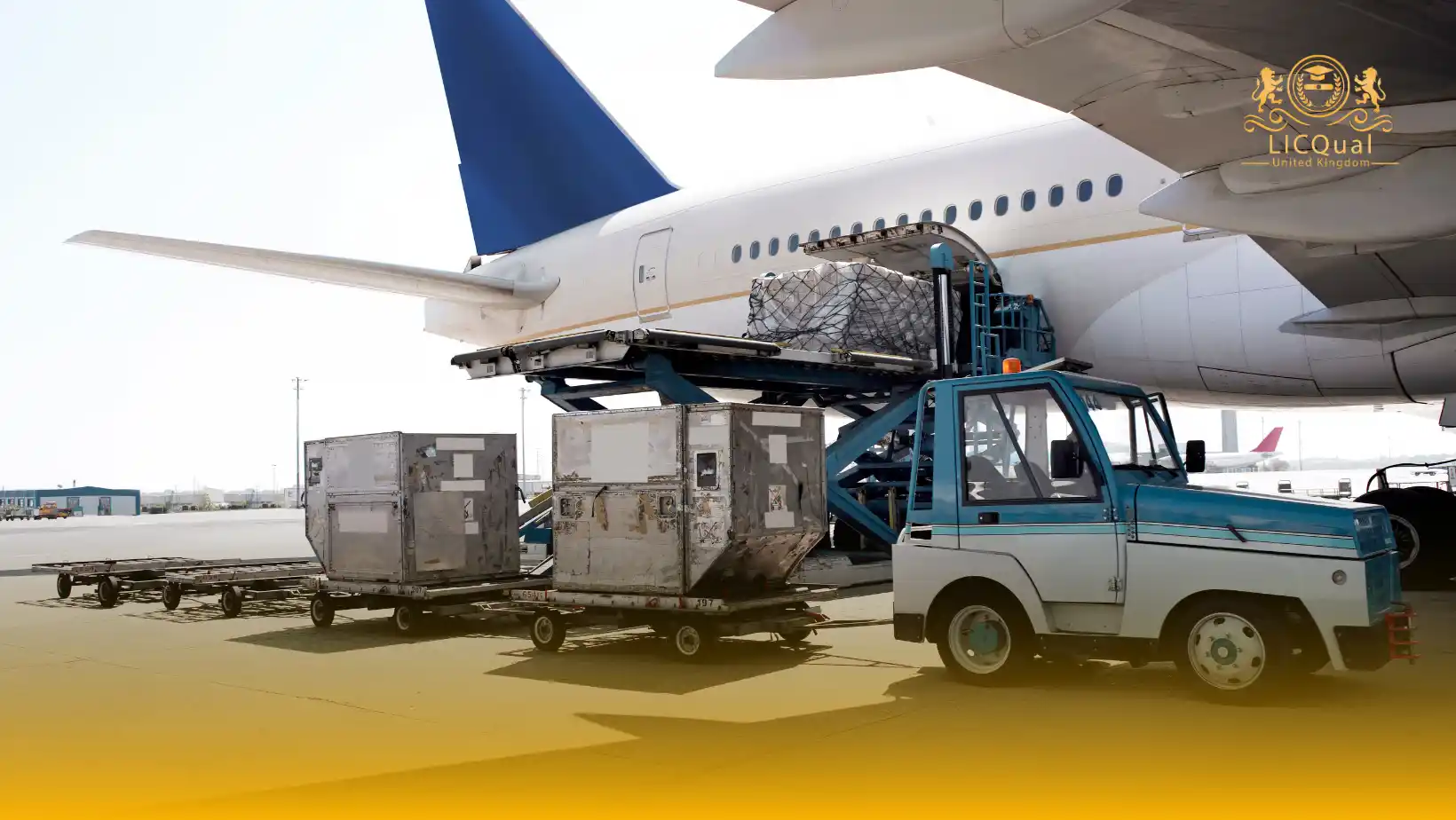
Airport and Cargo Operations
The LICQual UK Level 6 Diploma in Airport and Cargo Operations is an advanced qualification designed to equip the learner with comprehensive knowledge and strategic expertise in managing complex airport and cargo operations within the aviation industry. This course focuses on the advanced principles of Airport and Cargo Operations, including operational planning, logistics management, safety and security systems, and regulatory compliance. It provides the learner with a deep understanding of how airports and cargo services operate efficiently in a global aviation environment.
The course enables the learner to explore key areas such as cargo logistics, ground operations management, risk assessment, and performance optimization. The learner will gain insight into coordinating multiple airport functions while ensuring efficiency, safety, and adherence to international aviation standards. Emphasis is placed on real-world applications and strategic decision-making.
Through this qualification, the learner will gain advanced skills in leadership, critical thinking, and operational management within Airport and Cargo Operations, supporting improved efficiency, service quality, and sustainable growth in aviation environments.
Course Overview
Qualification Title
LICQual UK Level 6 Diploma in Airport and Cargo Operations
Total Units
6
Total Credits
120
GLH
480
Qualification #
LICQ2201262
Qualification Specification
To enroll in the LICQual UK Level 6 Diploma in Airport and Cargo Operations, applicants must meet the following criteria:
|
Qualification# |
Unit Title |
Credits |
GLH |
|---|---|---|---|
|
LICQ2201262-1 |
Global Airport & Cargo Strategy and Policy |
20 |
80 |
|
LICQ2201262-2 |
Advanced Cargo Operations & Integrated Supply Chains |
20 |
80 |
|
LICQ2201262-3 |
International Aviation Law, Compliance & Risk Governance |
20 |
80 |
|
LICQ2201262-4 |
Leadership, HRM & Organizational Development in Airport Operations |
20 |
80 |
|
LICQ2201262-5 |
Technology, Digital Transformation & Sustainable Logistics |
20 |
80 |
|
LICQ2201262-6 |
Dissertation / Applied Research in Airport & Cargo Operations |
20 |
80 |
By the end of this course, learners will be able to:
1. Global Airport & Cargo Strategy and Policy
By the end of this unit, learners will be able to:
- Analyze global airport and cargo policies and their impact on international aviation.
- Evaluate strategic frameworks for airport growth, cargo expansion, and trade facilitation.
- Apply knowledge of international aviation bodies (ICAO, IATA) to policy development.
- Assess the role of government regulations and global trade agreements in airport operations.
- Formulate strategies for sustainable airport and cargo management in a global context.
- Critically examine case studies of international airport and cargo policy implementation.
2. Advanced Cargo Operations & Integrated Supply Chains
By the end of this unit, learners will be able to:
- Demonstrate advanced knowledge of cargo handling, warehousing, and ramp operations.
- Integrate supply chain management principles into airport and cargo operations.
- Evaluate the efficiency of multimodal transport systems in global cargo logistics.
- Apply best practices in cargo security, safety, and international compliance.
- Optimize cargo flow through digital systems, automation, and real-time tracking.
- Assess the impact of global supply chain disruptions on airport cargo operations.
3. International Aviation Law, Compliance & Risk Governance
By the end of this unit, learners will be able to:
- Interpret international aviation law and its application to airport and cargo operations.
- Apply ICAO, IATA, and national regulations to ensure compliance in aviation logistics.
- Evaluate risk management frameworks for airport safety and cargo security.
- Demonstrate knowledge of liability, insurance, and contractual obligations in aviation.
- Assess the role of governance in maintaining ethical and legal standards in aviation.
- Develop compliance strategies to mitigate risks in international cargo operations.
4. Leadership, HRM & Organizational Development in Airport Operations
By the end of this unit, learners will be able to:
- Apply leadership theories to manage airport and cargo operations teams effectively.
- Demonstrate advanced HRM practices in recruitment, training, and workforce planning.
- Evaluate organizational development strategies for airport efficiency and growth.
- Foster a culture of safety, service excellence, and continuous improvement.
- Assess the impact of leadership styles on employee performance and customer satisfaction.
- Develop strategies for managing multicultural and international aviation teams.
5. Technology, Digital Transformation & Sustainable Logistics
By the end of this unit, learners will be able to:
- Demonstrate knowledge of digital systems used in airport and cargo operations.
- Apply ICT and automation tools for cargo tracking, logistics, and airport efficiency.
- Evaluate the role of artificial intelligence, blockchain, and IoT in aviation logistics.
- Assess strategies for sustainable logistics and green airport operations.
- Integrate digital transformation with international aviation standards and compliance.
- Analyze future trends in aviation technology and their impact on global cargo operations.
6. Dissertation / Applied Research in Airport & Cargo Operations
By the end of this unit, learners will be able to:
- Design and conduct independent research on airport and cargo operations.
- Apply appropriate research methodologies to aviation and logistics studies.
- Critically analyze data to generate evidence-based insights for the aviation industry.
- Demonstrate advanced academic writing and presentation skills.
- Evaluate real-world challenges in airport and cargo management through applied research.
- Produce a dissertation that contributes to professional knowledge and industry practice.
This course is ideal for:
- Professionals working in aviation, airport management, or logistics who want to advance their expertise in Airport and Cargo Operations and operational strategy.
- Learners aiming to develop advanced skills in airport planning, cargo logistics, and ground operations management.
- Individuals seeking to strengthen their understanding of international aviation regulations, safety standards, and compliance requirements.
- Airport supervisors and managers looking to enhance leadership, decision-making, and operational efficiency.
- Learners interested in mastering risk management, performance optimization, and strategic planning in aviation environments.
- Professionals transitioning into senior roles within airports, airlines, or cargo and ground handling organizations.
- Individuals involved in global logistics and supply chain operations who want to specialize in airport and cargo systems.
- Learners aiming to enhance analytical, problem-solving, and coordination skills in complex operational settings.
- Professionals seeking to improve service quality, operational efficiency, and safety in airport and cargo operations.
- Individuals looking to gain a recognized qualification to support career progression into leadership roles in Airport and Cargo Operations and aviation management.
Assessment and Verification
All units within this qualification are subject to internal assessment by the approved centre and external verification by LICQual. The qualification follows a criterion-referenced assessment approach, ensuring that learners meet all specified learning outcomes.
To achieve a ‘Pass’ in any unit, learners must provide valid, sufficient, and authentic evidence demonstrating their attainment of all learning outcomes and compliance with the prescribed assessment criteria. The Assessor is responsible for evaluating the evidence and determining whether the learner has successfully met the required standards.
Assessors must maintain a clear and comprehensive audit trail, documenting the basis for their assessment decisions to ensure transparency, consistency, and compliance with quality assurance requirements.