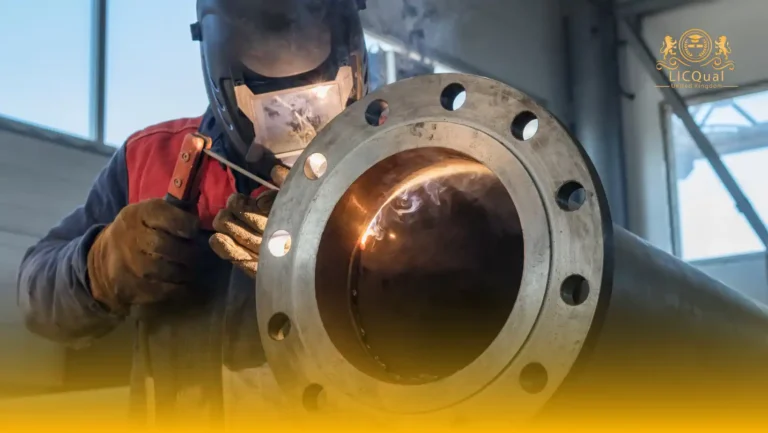
LICQual Level 3 Certificate in Quality Control and Quality Assurance (QA/QC) in Mechanical Engineering
Total Units
6
Total Credits
24
GLH
120
Learning Mode
Online
Assessment
Assignmnet based
Course Overview
The LICQual Level 3 Certificate in Quality Control and Quality Assurance (QA/QC) in Mechanical Engineering is a professionally designed qualification that equips learners with essential knowledge of mechanical inspection, quality management systems, and industrial standards. This course focuses on building strong foundational expertise in QA/QC practices used across manufacturing, fabrication, oil and gas, construction, and engineering industries. It helps learners understand how quality processes ensure safety, reliability, and compliance with international mechanical standards.
Through this program, learners develop practical skills in inspection techniques, documentation, non-destructive testing (NDT) basics, process control, and quality assurance procedures. The course strengthens the ability to identify defects, monitor production quality, and implement corrective actions in mechanical systems. It is structured to align with industry requirements, making learners capable of supporting quality teams in real-world engineering environments while improving accuracy, efficiency, and compliance with global quality frameworks.
Upon completion, candidates can pursue roles such as QA/QC Inspector, Mechanical Quality Technician, Site Quality Assistant, or Inspection Coordinator. This qualification is ideal for individuals aiming to enter or progress within mechanical engineering and industrial quality sectors, offering strong employability across national and international projects.
WHY CHOOSE THIS QUALIFICATION?
Strengthen Mechanical Quality Expertise
Gain in-depth understanding of mechanical QA/QC principles, including inspection methods, testing processes, quality assurance systems, and defect identification techniques. This helps build strong technical competence in mechanical engineering environments.

Industry-Focused Learning
Develop practical skills aligned with mechanical engineering industries such as manufacturing, fabrication, maintenance, construction, oil and gas, and heavy engineering. The course reflects real-world inspection processes and quality control requirements.

International Standards Awareness
Understand globally recognised quality management principles, mechanical engineering standards, regulatory requirements, and industry best practices. Learn how to ensure compliance and maintain consistent quality across mechanical operations.

Career Advancement Opportunities
Build essential competencies for roles in mechanical QA/QC inspection, quality control, testing supervision, auditing, and compliance functions. Strengthen your professional profile across engineering and industrial sectors.

Flexible Learning Options
Study through approved training centres with flexible delivery methods designed for both working professionals and new learners. This allows you to enhance your QA/QC skills without disrupting your work commitments.
Qualification Structure
Unit 1: Introduction to Quality Control and Quality Assurance in Mechanical Engineering
By the end of this unit, learners will be able to:
- Define the concepts of Quality Control (QC) and Quality Assurance (QA) and explain their roles in mechanical engineering.
- Distinguish between QC and QA in mechanical manufacturing and production.
- Explain the significance of quality standards and regulations (e.g., ISO 9001, ASME) in mechanical engineering.
- Recognize the stages of product development where QA/QC measures are applied, from design to manufacturing and final inspection.
- Describe the relationship between quality management practices and overall business success in mechanical engineering industries.
- Identify the tools and techniques used in QA/QC to ensure the quality of mechanical products.
Unit 2: Mechanical Engineering Quality Management Systems (QMS)
By the end of this unit, learners will be able to:
- Explain the fundamental principles of Quality Management Systems (QMS) in mechanical engineering.
- Identify the key components of a QMS, including quality policies, procedures, objectives, and performance measures.
- Understand how to implement a QMS within a mechanical engineering environment to meet industry standards.
- Apply the process approach within QMS to ensure effective planning, control, and improvement of mechanical processes.
- Evaluate the importance of continuous improvement (e.g., PDCA cycle) in enhancing product and process quality in mechanical engineering.
- Demonstrate an understanding of documentation control and its role in maintaining compliance with QMS requirements.
Unit 3: Inspection and Testing Techniques in Mechanical Engineering
By the end of this unit, learners will be able to:
- Identify different inspection techniques and testing methods used in mechanical engineering, such as visual inspection, dimensional measurement, and functional testing.
- Demonstrate the proper use of measurement tools and instruments (e.g., calipers, micrometers, and dial indicators) for quality inspections.
- Describe the role of inspection in ensuring compliance with engineering specifications and standards.
- Explain the importance of testing for product performance, reliability, and durability.
- Analyze inspection and test results to determine conformity to mechanical product standards and specifications.
- Apply inspection and testing techniques to detect defects, non-conformities, and process variations.
Unit 4: Non-Destructive Testing (NDT) in Mechanical Engineering
By the end of this unit, learners will be able to:
- Understand the principles of Non-Destructive Testing (NDT) and its significance in assessing mechanical materials without causing damage.
- Identify the main NDT methods, including ultrasonic testing (UT), radiographic testing (RT), magnetic particle testing (MPT), dye penetrant testing (DPT), and eddy current testing (ECT).
- Describe the equipment and procedures for performing each NDT method in mechanical engineering.
- Assess the advantages and limitations of different NDT methods based on material type, geometry, and application.
- Interpret NDT results to identify defects such as cracks, voids, corrosion, and other structural weaknesses.
- Document and report NDT findings in accordance with industry standards and regulations.
Unit 5: Root Cause Analysis (RCA) and Problem-Solving in Mechanical Engineering
By the end of this unit, learners will be able to:
- Explain the concept and importance of Root Cause Analysis (RCA) in identifying and resolving quality issues in mechanical engineering.
- Apply problem-solving tools and techniques (e.g., the 5 Whys, Fishbone diagram, FMEA) to determine the underlying causes of mechanical failures or quality defects.
- Demonstrate how to gather and analyze data to support RCA efforts, including using historical data, inspection results, and material specifications.
- Propose corrective actions based on root cause findings to prevent future occurrences of similar issues.
- Implement preventive actions in response to RCA findings and monitor their effectiveness over time.
- Evaluate the impact of root cause solutions on overall product quality, performance, and process efficiency.
Unit 6: Materials and Processes in Quality Control for Mechanical Engineering
By the end of this unit, learners will be able to:
- Identify various materials commonly used in mechanical engineering (e.g., metals, polymers, composites) and their properties that impact quality.
- Explain the role of materials selection in the design and manufacturing of mechanical products.
- Understand the key manufacturing processes in mechanical engineering (e.g., casting, forging, machining, welding, additive manufacturing) and their impact on product quality.
- Assess the effects of different manufacturing processes on material properties and product performance.
- Evaluate the potential for defects in materials and processes, such as porosity, distortion, and dimensional inaccuracies, and recommend methods for detection and correction.
- Apply quality control methods to ensure materials and processes meet specified mechanical and performance standards.
Eligibility
- Applicants must be at least 16 years old.
- High school qualification or equivalent is recommended.
- No prior QA/QC experience is required; basic understanding of mechanical or technical concepts is beneficial.
- Basic English reading, writing, and communication skills are required.